
How Scale-Driven Logistics Turns Small Enterprises into Industrial Giants
In the world of industrial expansion, growth is not a matter of luck; it is a matter of engineering. Most businesses reach a "plateau" where their production capacity outpaces their ability to deliver. They get stuck in a world that settles for mediocrity because they accept a logistics model that doesn't scale. But you do not get what you want in business; you get what you accept. If you accept a fragmented, truck-by-truck delivery system, you are accepting a limit on your own wealth. To be a standard-setter, you must look at your supply chain not as a cost centre, but as a supply chain survival asset.
The brain only notices a short sound bite that helps it survive. In the context of a scaling business, that sound bite is: Can my logistics handle ten times the volume tomorrow? For those relying on the status quo, the answer is often a confusing and expensive "no." For those utilising Indian railway cargo services, the answer is a clear, articulate "yes."
The Bottleneck of Mediocrity
Every hero in the story of business growth eventually hits a wall. They ask themselves: Is this current system going to solve my expansion problem? Did it work for someone else who scaled to a national level?
The problem is that traditional road transport is linear. If you want to move double the cargo, you need double the trucks, double the drivers, and double the fuel. This is "System 2" thinking: it is heavy, complex, and prone to breaking under pressure. When a business tries to grow using only road-haul, they find themselves in a constant "tollbooth" of rising costs and management fatigue. They burn mental calories on logistics when they should be burning them on innovation. To survive and thrive, you must move toward a nonlinear solution: rail freight logistics India.
The Physics of Railway Scale
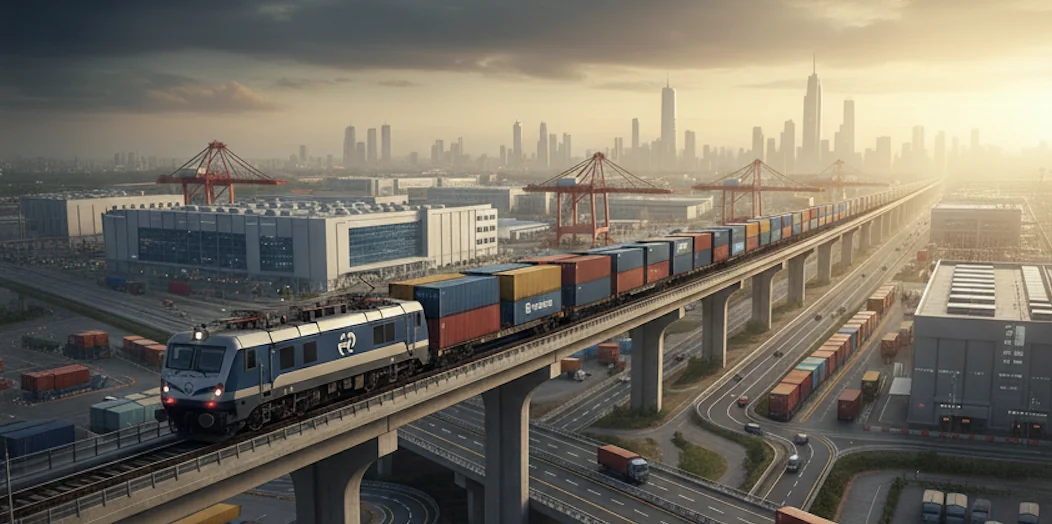
To move from aspiration to grounding, we must understand the logic of the rails. Indian railway cargo services are designed for "unreasonable" volume. With the Gati Shakti logistics push, the infrastructure is now in place to move massive amounts of industrial goods with a level of logistics supply chain efficiency that was previously reserved for only the largest conglomerates.
I recently watched a regional manufacturer attempt to take his brand national. He was a hero in his local market, but his "villain" was the interstate highway system. His growth was being choked by the unpredictability of road transit. He decided to set a higher standard and questioned the existing mediocrity of his delivery model. During a quiet pilot phase with multi-modal logistics solutions, he noted that his Prakash Express Cargo experience provided him with a "sense-making device" for his operations. Suddenly, moving 50 containers was as simple as moving five. By leveraging Dedicated Freight Corridors, he wasn't just moving boxes; he was moving his entire brand identity into a new tier of the market.
Why Rail is the "Standard-Setter" for Growth
If you want to be seen as an industrial giant, you must adopt the habits of one. Reliable railway freight offers three specific advantages that allow a business to scale without the stress:
- Volume Consolidation: Instead of managing 50 separate truck journeys, you manage one rail consignment. This is the definition of being "clear, not clever." It simplifies your reporting and your cost-effective freight transport strategy.
- Predictable Pricing (The Anchoring Method): Road rates fluctuate daily. Rail rates are stable. This allows you to "anchor" your long-term budgets. When you know your costs for the next six months, you can make bolder decisions. You can afford to be "unreasonable" with your goals because your baseline is secure.
- National Reach: Rail freight logistics India connects the ports to the heartlands through Dedicated Freight Corridors. It gives a small business the reach of a giant, boosting the "ego" of the brand by placing it on a national stage.
The 3-Step Plan to Unlocking Scale
Success requires a plan that feels doable. Here is how you transition from a local hero to a national powerhouse:
- Identify Your Growth Ceiling: Look at your current logistics. At what point does adding more trucks become a nightmare? That is your ceiling. To break it, you need multi-modal logistics solutions.
- Shift the Long Haul: Don't change everything at once. Keep trucks for the "last mile," but move your primary industrial bulk transport to the rails. As seen in the Prakash Express Cargo model, this blend is where the highest efficiency lives.
- Quote the Results: Once you have a stable, rail-based supply chain, use those numbers. Show your investors and clients your 100% "on-track" record. This social proof makes people trust what you have chosen.
The Transformation: From Surviving to Thriving
What does your life look like after you solve the problem of scale? You are no longer "small." You are a standard-setter. Your morning meetings are about new markets, not missing trucks. You have positioned your service as a necessity because your delivery is now as reliable as the infrastructure of the country itself. You have moved your containerised cargo movement into the "System 1" of the national economy.
The negative consequence of staying small is that you eventually become irrelevant. In a world of Gati Shakti-speed business, the slow and the fragmented will be left behind.
If you are struggling to scale your delivery to match your production, choosing to integrate Indian railway cargo services is the right decision. It is the transforming element that turns a local business into an industrial legacy. Be the hero who chose a better standard.